


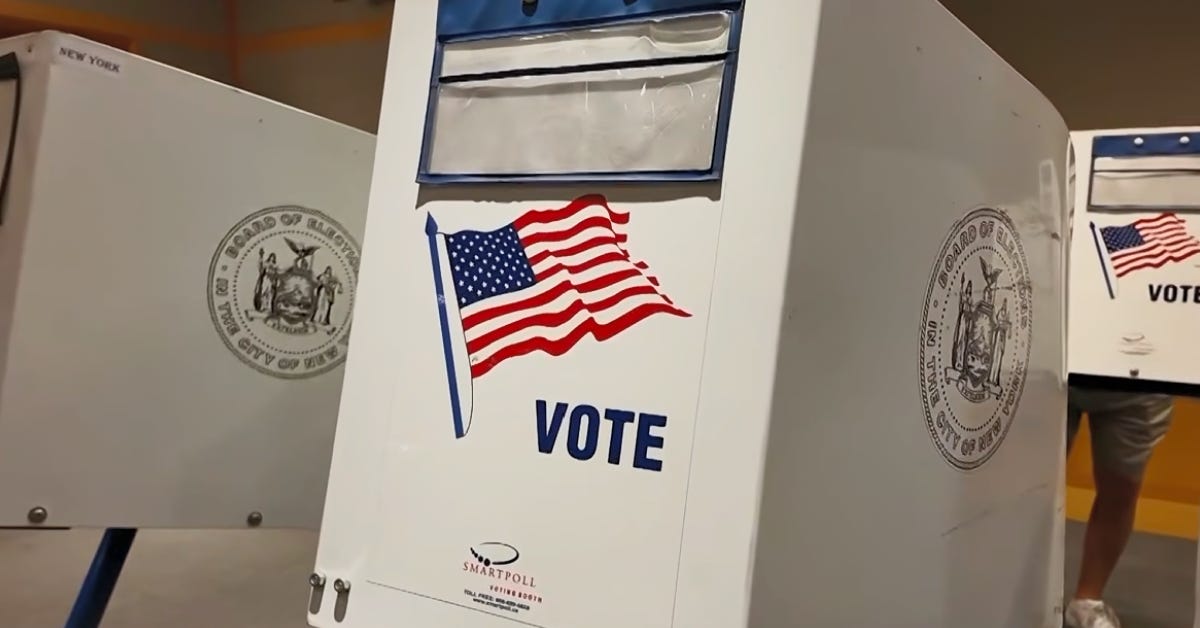
New York City is home to more than eight million people and represents one of the largest concentrations of political power in the United States. The city government oversees a gargantuan budget, the country’s largest public school system, the largest municipal police force, and makes decisions that affect everything from housing affordability to public safety. Yet, despite the extraordinary influence of city government over residents’ everyday lives, relatively few New Yorkers participate in choosing its leaders.
Low voter turnout has been one of the defining characteristics of New York City’s political system. While federal elections generate substantial participation, engagement falls sharply in state, municipal, and especially primary elections. In many legislative districts, City Council races can be decided by only a few thousand voters, while competitive special elections and local primaries generate single-digit turnout percentages.
Paradoxically, some of the elections with the lowest turnout choose the officials with the greatest influence over daily life; City Council members, borough presidents, district attorneys, and state legislators often attract the least public attention. Decisions about zoning, policy, public schools, and transit funding are made by officials whom many residents either know little about or never vote to elect.
Understanding why so few New Yorkers vote requires looking beyond reductive explanations such as apathy. The city’s low turnout is the product of history, institutions, demographics, and political culture. It also reflects the decline of the neighborhood political machines that once mobilized voters, dominance of one political party in the city, barriers created by election rules, and a growing sense among residents that their individual vote carries little weight. Together, these forces have transformed participation from a civic expectation into an increasingly optional act.
The modern turnout record is stark. An analysis of public and quasi-official sources together demonstrates a long record of weak municipal participation, punctuated by occasional spikes when contests become unusually competitive.
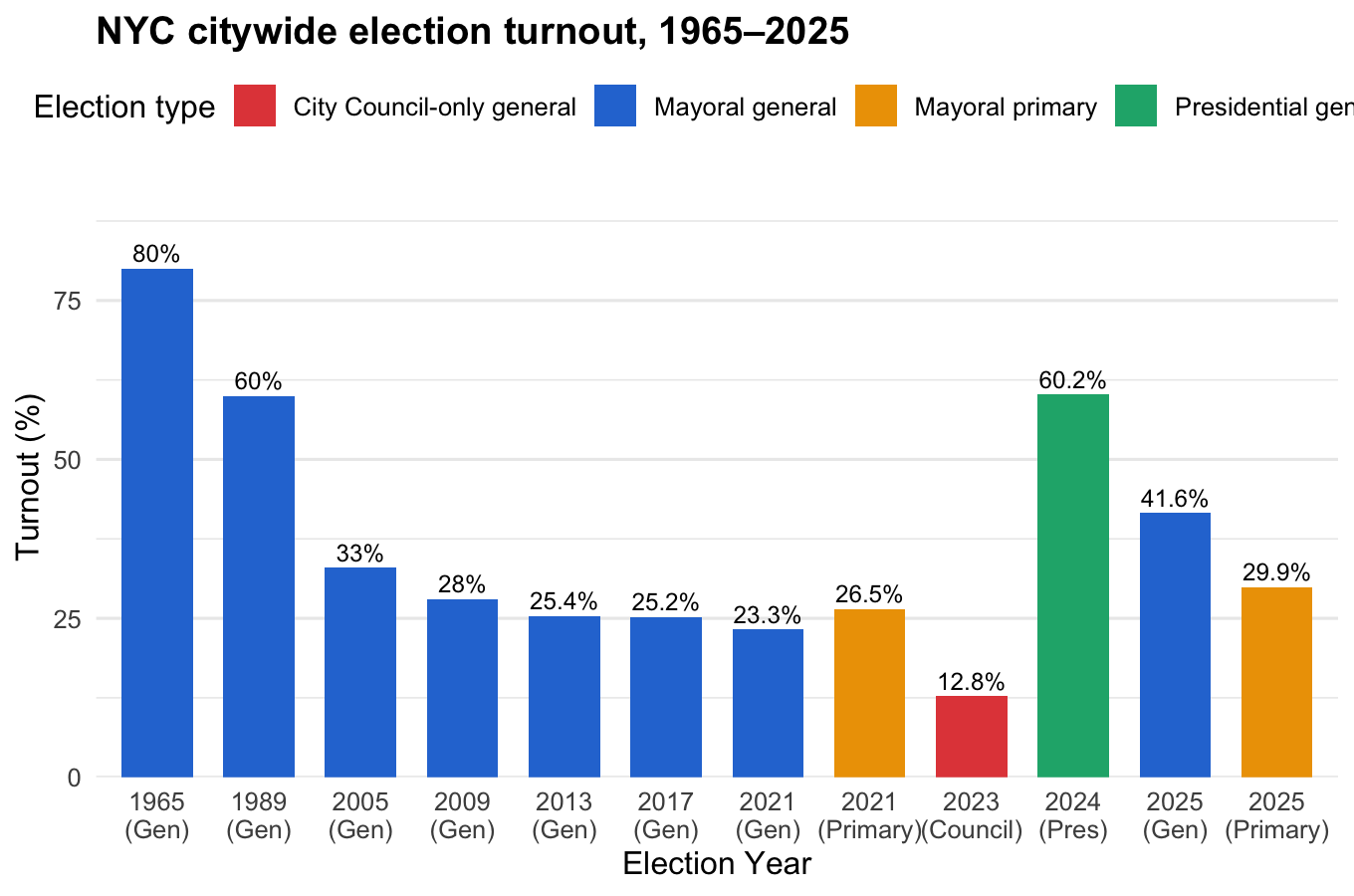
This time series tells two stories at once. The first is long-run decline: from older mid-century participation to a modern norm in which nearly three-quarters of registered voters routinely sit out of municipal elections. The second is conditional: turnout is not fixed. Turnout rises when the race is unusually competitive, polarizing, or nationally visible, as in 2025; it collapses when elections lack salient or competitive contests, as in 2023. That pattern implies that New York City’s turnout is heavily influenced by election timing, competition, and information.
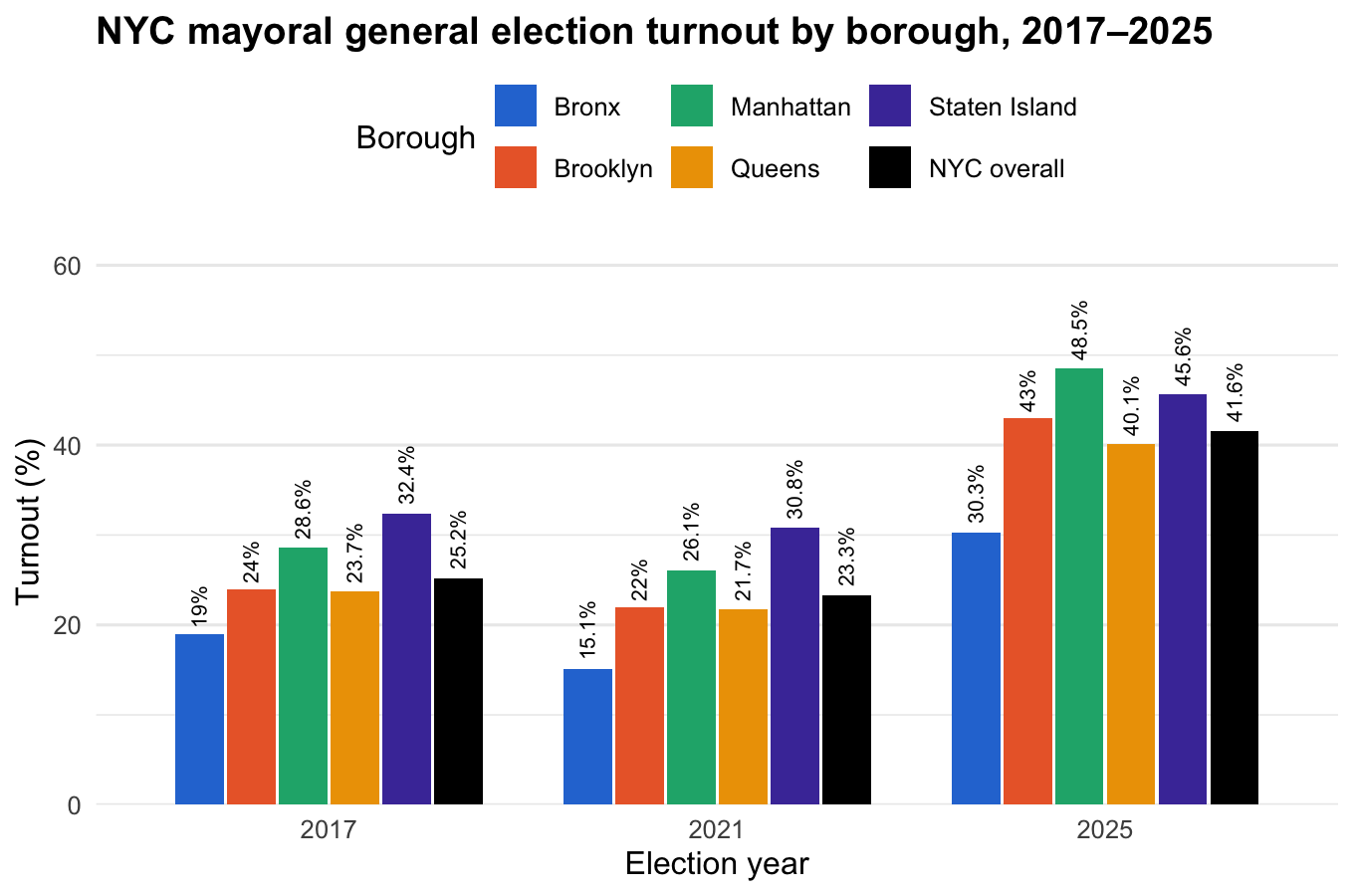
The borough pattern is also heavily unequal. In 2017, turnout ranged from 19% in the Bronx to 32.4% in Staten Island, compared to a city-wide average of 25.2%. Turnout decreased city-wide in 2021, while the same broad geographic hierarchy persisted. In 2025, turnout in every borough sharply increased, but the gap persisted: 30.3% in the Bronx, compared to 48.5% in Manhattan and 45.6% in Staten Island. The data demonstrate that the city’s turnout problem is geographically concentrated, with the greatest disengagement in neighborhoods that also tend to have lower incomes, more residential churn, and weaker long-run participation habits.
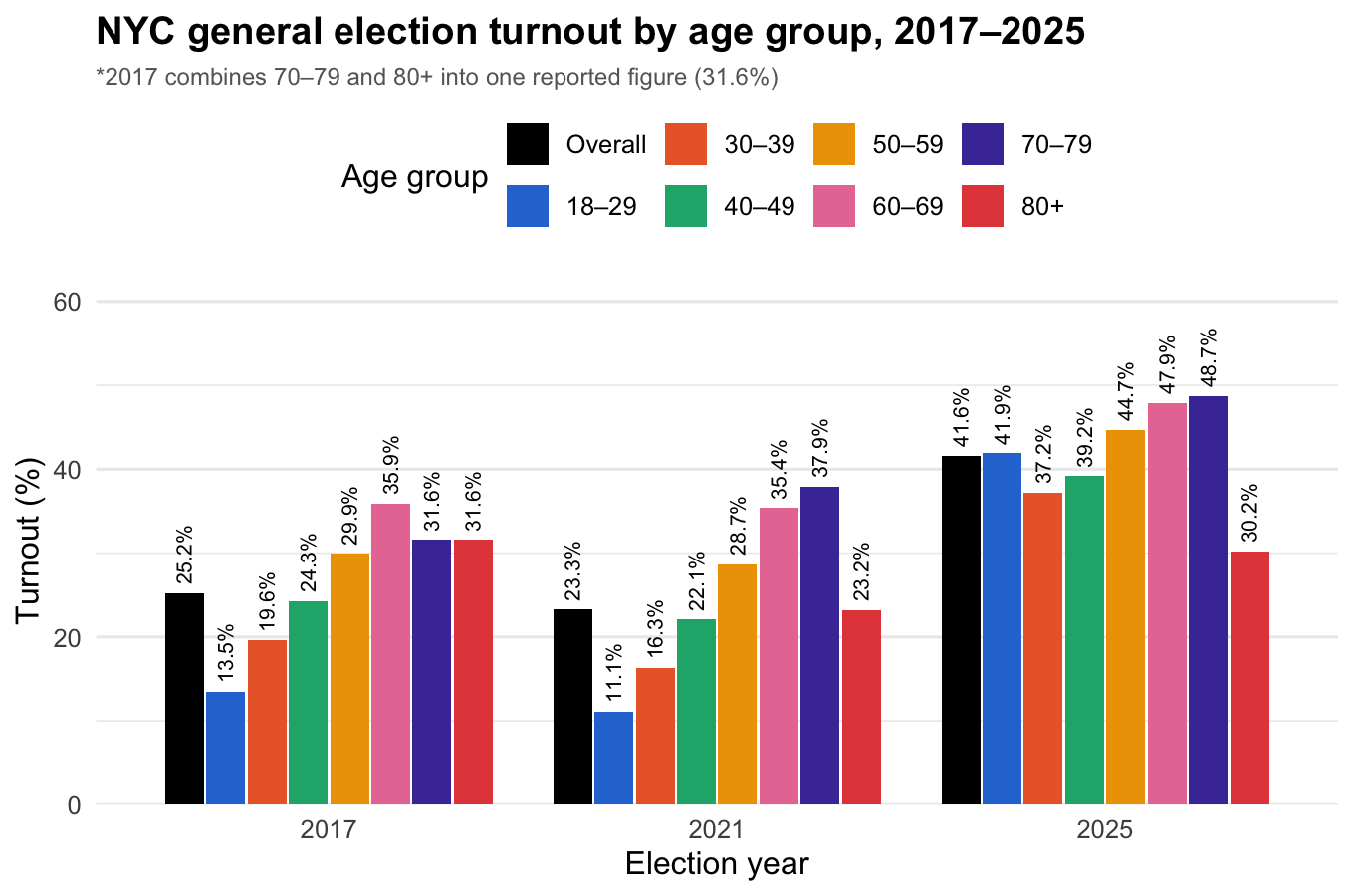
Age is even more stratified. In the 2017 general election, turnout ranged from 13.5% among voters aged 18-29 to 35.9% for voters aged 60-69. This age gap remained stark in 2021, where youth turnout fell to 11.1%, while turnout for voters aged 70-79 rose to 37.9%. In the 2025 general election, youth turnout surged to 41.9%, slightly outpacing the city-wide average of 41.6%, but it still lagged behind turnout for voters aged 70-79 at 48.7%. It is not that young New Yorkers do not vote; 2025 shows that they can and do when conditions change, but the average New York election is bad at activating them.
The single most important structural fact is that many elections are held in off-cycle, odd-numbered years, outside the high-salience federal calendar. In recent decades, New York City mayoral general-election turnout has hovered in the mid-20s as a share of registered voters, while presidential turnout has been roughly twice as high. Just 23% of the city’s eligible voters voted in 2021, compared to 60% in the 2024 presidential election. That issue is persistent, as turnout has consistently been around 30% since 2005 (excluding 2025), while the city’s presidential election turnout has consistently exceeded 50% over that same period. In other words, the city’s turnout problem is not that New Yorkers never vote; it is that many do not vote in local elections held on low-attention dates.
A second major driver is institutional exclusion in primaries, which are often the real election in a heavily Democratic city. New York’s primaries are closed, and party enrollment changes for a June primary must be received by February 14, months before most voters know who the candidates are. Official and semi-official New York City election research repeatedly identifies this as one of the country’s more restrictive primary systems. Meanwhile, unaffiliated voters are a very large bloc: the New York City Campaign Finance Board reported that they were 20.6% of registered voters in 2025 and 21.1% in 2024, with younger voters disproportionately represented among them.
Third, turnout is shaped by who is asked to bear the costs of participation. Recent city studies show that low participation is concentrated among the young, the mobile, the less educated, naturalized citizens, and neighborhoods with weaker voting habits. Earlier tract-level New York City research similarly found lower turnout in areas with more younger adults, men, low educational attainment, naturalized citizens, and recent movers. These patterns suggest that the burdens of participation, such as maintaining registration and familiarity with local politics, are not evenly distributed among the electorate.
Fourth, competition matters enormously. When ballots are uncompetitive, turnout collapses; when local races are high-stakes and salient, turnout rises sharply. The CFB found that the 2021 mayoral primary reached 26.5%, the highest mayoral primary turnout in decades, but the 2021 mayoral general fell to a then-record low 23.3%, which the report explicitly linked to the race’s relative lack of competitiveness. In 2023, when there were no citywide offices and few competitive council contests, turnout fell to 7.2% in the primary and 12.8% in the general. By contrast, the highly publicized and competitive 2025 mayoral election pushed turnout to 41.6%, the highest city-election turnout in over half a century.
Fifth, the city’s low-turnout equilibrium is reinforced by administrative complexity, information gaps, ballot design, language-access limits, and weakened local media. Early voting and no-excuse vote by mail have reduced friction, but official reports show persistent burdens: unequal early-voting site distribution in 2019, long travel distances in some neighborhoods, confusing party-change deadlines, lagging ballot-tracker information, and continuing language-access gaps outside federally protected languages. At the same time, research on local journalism finds that declining local political news reduces civic engagement, and city-specific election research notes that simply communicating the existence and timing of off-cycle elections has become harder in the contemporary media environment.
The modern turnout record is stark. Public sources show a long period of weak municipal participation, punctuated by occasional spikes when contests become unusually competitive. But turnout in earlier New York was higher for reasons that were not wholly democratic in the modern normative sense. Under Tammany Hall and related machine structures, local politics were deeply embedded in neighborhood life, ethnic networks, patronage, and material exchange. Recent historical work on Tammany Hall finds that the city’s machine relied on district leaders who oversaw voter mobilization in primaries and general elections, often through patronage networks and reciprocal obligations. Incentivized to mobilize their neighbors by direct rewards, Tammany-era New York often reported over 80% turnout among registered voters.
That helps explain why “turnout used to be higher” is the wrong lesson if read without the relevant context. Earlier turnout was elevated not only by stronger civic attachment, but also by strong parties, denser ward organizations, social pressure, and the exchange of jobs or favors for mobilization. Historical scholarship on urban patronage machines generally ties their rise and fall to immigrant urban electorates and patronage-based organization. Election-timing scholarship further shows that local election calendars themselves were historically manipulated by parties seeking advantage, highlighting that turnout levels have always been partly manufactured.
There is also a less machine-centered explanation for the mid-century peaks: some historical races were genuinely gripping citywide contests. For instance, 1965 and 1989 are used as the relevant historical years because those mayoral contests were unusually competitive and city-defining. That is consistent with the modern record: New Yorkers vote when they believe the stakes are immediate and the result is uncertain. What has changed is that later municipal elections have often featured less competition, weaker local party organizations, and a much more fragmented local information environment.
The long-run decline, then, is best understood as the combined effect of the demise of machine-era mobilization, the professionalization and depatronization of government, the migration of political attention to state and national arenas, and the persistence of off-cycle local elections. That shift removed coercive forms of mobilization, but it also left the city without a comparably strong, legitimate infrastructure for habitual local participation.
There are several explanations as to who votes and who doesn’t. Of those, the clearest consistent pattern is age. New York City official analyses across multiple cycles repeatedly show that older voters participate at higher rates than younger voters. In 2023, only 6.1% of eligible registered voters ages 18-29 voted in the general election, while the average age of 2023 general-election voters was 57, compared with 50 for all registered voters. In 2021, the average general election voter was 55. In 2025, youth turnout improved dramatically, reducing the average voter age from 55 to 50, but even that surge underscores how abnormal ordinary local elections are for young adults.
Past voting records can also indicate future participation. The CFB’s ten-year participation-score study found that only 3.1% of voters cast a ballot in every election for which they were eligible from 2008 to 2018, while 21.4% never voted once during that span despite being registered and eligible for at least one election. They created a participation score by dividing how many elections a voter participated in by how many they were eligible for, and they found that the average participation score was approximately 29, with Manhattan highest (34) and Bronx lowest (24). That is strong evidence that the city suffers not just from one-off abstention but from a pattern of habitual nonparticipation.
Education and income matter, but the city evidence is more nuanced. In the CFB’s 2012 report, less educated tracts voted at lower rates, and chronically low-voting tracts had lower median household incomes and much higher shares of residents with no education beyond high school. In the 2008-2018 participation-score model, educational attainment remained a key positive predictor of participation, while higher-income households were a positive but weaker predictor. The takeaway is that socioeconomic resources matter, but education appears especially central because it overlaps with political knowledge, efficacy and administrative capacity.
Residential mobility is another important but under-discussed factor. The CFB’s 2012 analysis summarizes the broader literature showing that moving reduces turnout because re-registration is inconvenient and because movers are less rooted in neighborhood social networks. The same report found that high-voting tracts had a larger share of voters living in the same home as one year earlier. This matters especially in New York, where high rents, frequent moves, and address changes can interact with registration maintenance and primary-enrollment rules. Official state deadlines still require change-of-address notices to be processed at least 15 days before an election.
Similarly, language access is both a demographic and logistical issue. The CFB estimated that of the city’s 1.8 million limited-English proficient residents, roughly 300,000 spoke languages not protected by the Voting Rights Act. New York now offers services at select sites in eleven languages in addition to Spanish, Bengali, Chinese, and Korean, but this still excludes the broader population.
New York City’s party system depresses turnout in a distinctly local way. The city is so Democratic that the general election frequently feels secondary, yet one in five registered voters is unaffiliated and cannot participate in the Democratic primary without having enrolled months earlier. That combination weakens the sense among many voters that their participation is both possible and consequential.
Candidate quality and campaign strategy matter too. The campaigns of 2025 included heavy mobilization, cross-endorsements, and a race framed around affordability, bringing young and first-time voters into the electorate. Mayor Zohran Mamdani’s campaign demonstrated how candidates can also circumvent some of the weaknesses of the traditional local media ecosystem. His campaign made extensive use of social media to communicate directly with New Yorkers, particularly younger voters. That strategy helped make municipal politics visible in the places where younger New Yorkers already encounter political information. By contrast, the 2021 general election and the 2023 municipal cycle were less competitive, had lower enthusiasm, and featured limited voter education. Local turnout is contingent on whether campaigns make city politics feel urgent and relevant.
The media environment reinforces all of this. Broad research shows that declining local political news reduces civic engagement, and New York is among the metro areas most affected. In an era of local-news decline, simply informing residents that an off-cycle election is happening and why it matters is itself a daunting task. While digital channels can partially fill the gap, they do not create a broad civic-information commons in low-salience years.
New York City’s turnout problem has no single cause. It is the cumulative product of elections held when fewer people are paying attention, a dominant-party system that shifts meaningful competition into closed primaries, barriers to registration and participation, and campaigns that too frequently fail to make elections feel consequential. These forces reinforce one another: when an election feels unimportant or difficult to navigate, fewer people participate — and it becomes easier to ignore the next cycle.
If New York City wants to meaningfully increase turnout, the evidence first turns to election timing. Comparative evidence is consistent in saying that municipal turnout increases when local elections coincide with higher-salience federal elections. But New Yorkers rejected a proposal in 2025 to align municipal elections with the presidential cycle. Since this proposal failed, it will likely be some time before it comes up for referendum again.
Other solutions remain accessible in the meantime. Lowering registration barriers could expand participation even without changing the election calendar. While same-day voter registration would require a New York State constitutional amendment, switching the party registration deadline to match the general deadline of 10 days out could be accomplished by changing the state election law. Easier still, institutional changes, such as increasing the number of languages included on a ballot, can be amended by the Board of Elections.
Many of the other measures discussed here, such as switching election timing, increasing the number of candidates, and easing turnout, can only be fixed through civic engagement, whether that be more candidates running or direct advocacy. Solving the problem of political disengagement requires participation from the very people the current system fails to engage.
That paradox might seem impossible to overcome, but New York’s recent elections suggest that low turnout is not an immutable city fixture. When voters believe an election is competitive, when a candidate gives them a compelling motive to vote, and when information about the stakes reaches them where they are, people vote. The question, then, is not only why turnout is low, but why the political system fails to convince people that their votes will matter.
No single reform can fix that. Election timing can bring more voters to the polls, registration reform can make participation easier, stronger local media can increase election visibility, and competitive campaigns can make their outcomes feel tangible. But each addresses a different dimension of the same underlying problem: too many New Yorkers experience democracy as something distant from their everyday lives, even though the decisions made through that democracy shape daily life.
New York has a politically active population. Its citizens organize, protest, celebrate, debate, volunteer, and advocate constantly. The challenge is translating that political fervor into sustained electoral participation, not only when a presidential race dominates national media or a polarizing candidate motivates turnout, but in the quieter elections that determine who governs neighborhoods, writes local laws, and controls the institutions closest to quotidian life.
Turnout is more than a measure of how many people cast a ballot. It is a measure of how many people believe our political system is something worth showing up for. Increasing turnout in New York City, therefore, is not simply about getting people to vote. It is a matter of building a civic system that gives people a reason to go to the polls.