
The Left Has No Easy Choice in NY-12
For left-wing voters across the district, the race offers disappointment, ambivalence and no clear political home.

NY-12 is not a test of whether the left can win a Manhattan congressional primary. The Left has already failed to field a financially competitive candidate. The real test is whether an energized Left that ushered Mayor Zohran Mamdani into NY-12’s most famous residence can breach the heart of Democratic elite politics: a district of donors, media professionals, institutional liberals, and voters exhausted by a race in which nearly everyone sounds more distinct in style than substance.
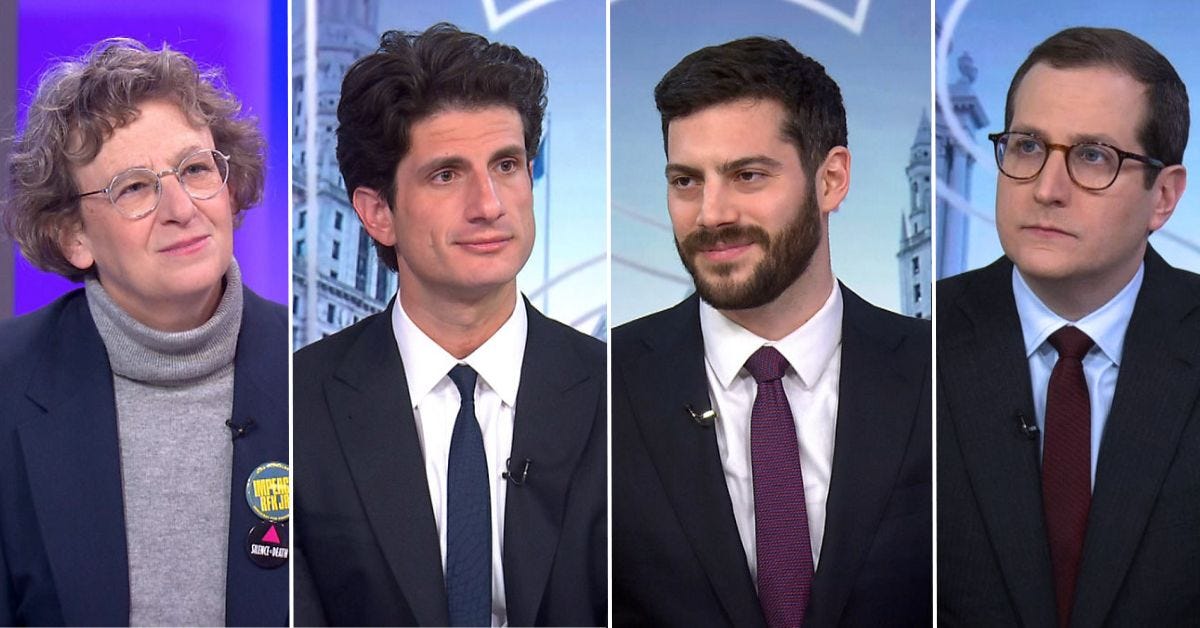
As of this writing, the race appears to be a two-way fight between Upper East Side Assemblymember Alex Bores and Upper West Side Assemblymember Micah Lasher, with Kennedy heir Jack Schlossberg and lawyer George Conway both seeing the narrowest of paths to a win.
The only candidate in the race running explicitly on the Left is Nina Schwalbe. Her campaign has struggled to catch fire in a post-Citizens United world in which no level playing field exists, and competition requires huge sums of cash. The resulting competitive race between only white men feels almost too on-the-nose as a representation of Trump-era social regression.
The fault lines between these leading candidates aren’t as clear as in the race happening just south of the district, where former New York City Comptroller Brad Lander is clobbering Rep. Dan Goldman in the polls.
But lines do exist in NY-12, and voters are doing their best to make sense of the fissures.
Institutional favorite Lasher has made domestic anti-authoritarianism and fighting Trumpism the hallmark issues of his campaign. Union and progressive organizational favorite Bores has become a national face in the conversation about how to regulate AI, in part because of OpenAI-world’s stalwart opposition to his regulatory framework and Anthropic-world’s support for it.
Jack Schlossberg has little institutional backing but polls alongside George Conway as the only alternative to the leading candidates with any theoretical path, framing himself as an unbought outsider to legislative politics ready to bring a clean slate to the office. The notion that a Kennedy could even try to frame himself as an outsider is a signal about, or perhaps an indictment of, the level of wealth and insider politics at play in this district.
On the local side, Bores and Lasher can count East and West Side Democratic clubs among their coalition, respectively, with citywide LGBTQ+ clubs lined up behind Bores.
The leading candidates agree on domestic policy to a degree that makes them almost interchangeable to the majority of voters, although each candidate would bristle at such an assessment. To live inside a political system is to feel every fault line deeply. But given a lack of major ideological difference, each candidate instead faces character attacks with varying degrees of truth and hyperbole.
The median Democratic primary voter in NY-12, if such a thing exists, might be called a traditional liberal: affluent, highly educated, reflexively anti-Trump, and broadly comfortable with the institutions that have defined the district for decades. It is also the most Jewish congressional district in the country, making Israel a distinctly local political fault line. Jewish voters are not a monolith on this issue, but candidates must navigate an older, more institutionally connected Jewish electorate alongside younger voters, including many younger Jews, whose politics on Israel and Palestine diverge from their elders’. Do they reassure the district’s institutional liberal and pro-Israel constituencies, or signal alignment with its growing left-wing bloc?
Bores and Lasher have settled into a rhetorical dance to navigate the issue that makes both sound like a step backward from Nadler. One could be forgiven for losing count of how many times these candidates have used their go-to Leahy Law dodge to avoid taking a direct position on stopping the genocide by any legislative means necessary.
It cannot be overstated how sharply Democratic voters have moved on this issue. Gallup found 65% now sympathize more with Palestinians, compared with 17% who sympathize more with Israelis.
Schlossberg has taken a position to Bores and Lasher’s left, making clear his support for conditioning aid and blocking certain arms sales to Israel while continuing Iron Dome funding. It’s not a left-wing position, just left of the other leading candidates. That might be enough to pull voters who cast ballots for Mayor Zohran Mamdani in a race where no candidate with the fundraising necessary to be competitive represents their perspective.
On domestic issues, Bores supporters portray Lasher as a shapeshifter, while Lasher supporters echo the same sentiment in the other direction. The race is a bit of a Rorschach test for voters on the domestic front who will point to Lasher’s movement on issues from his previous government service to his legislative work, but conversely point to Bores moving right during his congressional run, such as dropping sponsorship for a sex work decriminalization bill and speaking in a pro-Israel cadence that either wasn’t happening before or escaped notice.
The issue for Schlossberg is the same on both domestic and international issues: voters have to take him at his word because he would be a first-time legislator, doesn’t have a legislative record to evaluate against his statements and maintains a bizarre online persona. Left voters using international policy as a litmus test might make that gamble.
The overwhelming sentiment from voters I’ve spoken to throughout the district about the race is exhaustion. “I know who I’m not voting for,” an exasperated resident told me at a recent dinner after receiving one too many pieces of direct mail. But this voter was still struggling to navigate between the similar candidates.
I asked Ellen Bender, NY-12 voter and co-founder of activist group Markers For Democracy, how she was navigating the race as a voter on the Left.
“The race is really dividing our progressive groups. We have some die-hard Upper East Side Bores supporters, some die-hard Upper West Side Micah supporters, and then a bunch of us who are disappointed with their positions on Israel and Palestine who are supporting Nina or Jack. No one I know is supporting George Conway,” Bender told me. “The whole country is moving to the left on Israel and Palestine. Judging by the positions of two of the three leading candidates in the primary, this district is moving to the right. I don’t know if that is actually true - if the two front-runners are running cautious campaigns or if they themselves are genuinely to the right of Jerry Nadler.”
Indeed, the unwillingness of leading candidates to engage clearly on Israel has become par for the course in a race marked by obfuscation. These candidates seem unwilling to stand for anything that could be considered a risk in the district, even if the issue is among the greatest moral challenges of our time. The only candidate who doesn’t channel an obvious sense of risk aversion is anti-Trump conservative Conway, whose loose-cannon style straddles a line somewhere between charming and unnerving. In a race defined by calculated dullness, it’s downright invigorating, even if his politics are an absolute nonstarter for progressive and Left voters.
“This district is in many ways the epicenter of the Democratic Party elite. This is where our media apparatus is located. This is where candidates from across the country solicit high-dollar donations,” political analyst and NY-12 voter Eli Miller told me. “What this race tells me is that the Democratic Party elite is so blindingly focused on strategy and figuring out how to win again that they have become completely indifferent to debates about actual policy issues. The candidates are desperate not to talk about Israel if they don’t have to. They’re not fighting with each other over tax policy or any other class politics issue. The only thing any of them really want to communicate is: I know how Democrats can win again, and it’s by electing people with my particular aesthetic.”
Michael Lange, a political analyst born and raised in the district, explained to me the ambivalence experienced by voters who see themselves in none of the leading candidates:
“The Left, broadly, feels somewhat adrift in NY-12. On Israel-Palestine, a top issue to leftists under-50, Lasher and Bores appear indistinguishable. Schlossberg has changed his tune on offensive weapon aid recently, but it is hard to gauge what is sincerity versus politicking. The differences between the top contenders are far more stylistic and aesthetic than they are ideological. There was a time and a lane for one of them to emerge as the true progressive standard bearer. Mamdani’s +46 approval rating proves it. But no one seized it.”
Lange’s point about Mamdani is important: Emerson/PIX11 found Mamdani with 66 percent approval among likely Democratic primary voters in NY-12, contradicting the notion that he is toxic in the district.
Many voters in the district wish to see a leading NY-12 candidate bring the substance and style of politics that Mamdani brought to his own campaign.
Paloma Naderi, co-founder of Moms for Mamdani, offered a conflicted perspective on the race:
“For many lefty New Yorkers like myself, it’s been sobering to pivot focus to NY-12 after experiencing the hope injected by Zohran Mamdani’s election: a campaign that put human rights and structural inequality at its center. This forced focus-shift is a stark reminder for me that my NYC apartment sits in multiple jurisdictions, and this race highlights the distinct political climate of the Upper East Side; my neighborhood did not decide the Mayor’s race, but it may very well decide this one. This is an urgent moment in national politics, especially on two particular issues: Israel-Palestine and AI.”
Naderi continued:
“Unfortunately, I don’t believe any of the NY-12 frontrunners’ views on Israel-Palestine are meeting most Americans where they are, as the majority move toward recognition of US and Israel’s action in Gaza as a genocide. On the second issue, we desperately need AI regulation. Alex Bores is the only candidate who has shown dogged commitment to winning sorely needed, common sense AI safeguards, despite plenty of dark money trying to prevent him from doing so. Bores has also demonstrated a willingness to listen to critique and possibly embrace a Left that’s not fully on board with him. That’s why most folks I speak with are quietly supporting him.”
What left-wing voters understand is that the race in NY-12 will not be a data point for the national party about the viability of left-wing politics represented by candidates like Schwalbe in more conservative or moderate Democratic districts. The wealth of this district is so high that it isn’t representative. But the three leading candidates do represent different levels of institutional ownership.
A decade after Republicans surrendered to an insurgency, Democrats are now facing one of their own. NY-12 will demonstrate how much of the populism at the gates has breached the party’s upper echelons and whether it can be held back any longer.
Democrats’ revolt may be more humanity-affirming and democratic than its GOP counterpart, but it’s still a hostile takeover. In a district as wildly privileged as NY-12, the closest possible outcome to rejecting the institutions might somehow be the election of a Kennedy.
---
(Authorial disclosure: Due to the nature of my work, I am a member of multiple organizations that make endorsements in NY-12. I am not personally affiliated with any active campaign in this race, and my views are strictly my own.)


